Proactive 50-State Regulatory Compliance and 100% Software HNDL and Quantum Data Encryption Solution.
(Fully Installed in 90 Days)
Eliminate personal liability for regulatory compliance across all 50 states. It's the 100% software solution executives demand. No rip-and-replace required.
PQC+™ fuses access controls directly into NIST-certified post-quantum cryptography, giving you end-to-end protection against Harvest Now, Decrypt Later (HNDL) attacks while proactively enforcing, and future proofing, federal and all-50-state regulatory compliance at the data layer — automatically.
Serving mid-tier enterprises, government agencies, healthcare systems, and academic institutions
Fewer than 5% of executives know they're now personally criminally liable in all 50 states — simultaneously.
URGENT: Your Corporate Shield is Gone. Effective January 2026, new 50-state regulations make CEOs, CTOs, CISOs, and Board Members personally and criminally liable—meaning jail time—for regulatory compliance failures. This is not a future threat; these are laws being actively enforced in all 50 states. See the definitive proof now. Download the 15-page PDF below. Turn to Page 9 (under the State Levied Penaltiescolumn) to see the blue 'Criminal' hyperlink for all 50 states. These links are saved Google searches. See the convicted executives, their restitution, license suspensions, and their prison sentence. This is what our PQC+ proactively protects c-suite executives and their organizations from.
Your encrypted data is being stolen today. Liability hits when it's stolen, not when it is decrypted.
Every day you delay PQC migration increases your personal liability exposure. C-suite penalties under the new federal DOJ DSP goes up to 20 years imprisonment and $1M+ per violation. State violations go up to 50 years and $30 million in penalties.
Crises Warnings from Major CPA and Consulting Firms
EY Law & Corporate Governance Center1 of 13"Regulatory warning shots have been replaced by structural operational penalties. Enforcement agencies are no longer negotiating minor corporate settlements; they are aggressively targeting the financial fruits of non-compliance through immediate disgorgement, operational halts, and individual C-suite accountability."
Gartner Legal, Risk & Compliance Practice2 of 13"The window for voluntary or gradual alignment with cross-state and federal data laws has closed. The cost of non-compliance is now 2.7 times higher than the total cost of implementing protective compliance technologies. Executive leaders face an impending crisis for enterprise survivability if governance remains an afterthought."
Deloitte Financial Risk Advisory3 of 13"Organizations operating under the assumption that they will receive a 'notice and cure' window are facing an existential blind spot. Modern enforcement architectures are designed for zero-tolerance; when an architecture gap or data violation is audited, penalties are issued automatically and retroactively."
PwC Global Regulatory & Risk Survey4 of 13"Staying ahead of risk is an organization-wide mandate. The assumption that compliance is a back-office utility or an IT problem is an enterprise-ending mistake. Firms operating without proactive, automated technical guardrails face market exclusion and immediate asset freezes as the regulatory environment hardens."
KPMG Forensic & Regulatory Briefings5 of 13"We are moving out of the era of the 'regulatory warning shot.' State and federal agencies are deploying continuous data monitoring tools that flag infractions in real time, shifting the regulatory reality from delayed civil negotiation to swift operational and asset penalties."
Morgan Stanley — Global Compliance & Financial Risk Directives6 of 13"When regulatory non-compliance crosses the threshold into corporate fraud, the protection of the corporate structure evaporates. Enforcement agencies are actively utilizing pre-conviction asset forfeiture laws to instantly seize business treasuries, freeze liquid capital, and mandate top-line corporate restitution—meaning the financial rewards of compliance failure are dismantled before a defense can even be mounted."
KPMG — Global Advisory on Regulatory Proximity7 of 13"Manual, retroactive compliance checklists are an explicit corporate vulnerability. Modern regulations require continuous, proactive software-driven monitoring. Firms operating under the illusion of a 'notice and cure' window face market exclusion, immediate litigation, and catastrophic brand damage within hours of an architecture failure."
Deloitte — Regulatory Enforcement Insights8 of 13"Personal liability is the new reality for corporate officers. Regulatory enforcement has pivoted away from corporate-level agreements and moved directly into the boardroom. C-suite executives now face active criminal prosecution, personal asset liquidation, and multi-million dollar individual restitution mandates for systemic technical or data oversight failures."
KPMG — Forensic Governance & Risk Report9 of 13"The enforcement architecture has changed from a model of delayed civil penalties to immediate operational and financial seizure. Under modern federal and state statutory frameworks, prosecutors have the authority to bypass lengthy court protocols to freeze corporate bank accounts, halt daily business operations, and seize properties funded by non-compliant revenue streams."
Deloitte Center for Regulatory Strategy10 of 13"The era of the regulatory grace period is over. As new data privacy, artificial intelligence, and structural frameworks mature, regulators are pivoting decisively from education to strict enforcement, leaving non-compliant enterprises exposed to immediate financial remediation."
KPMG Global Chief Compliance Officer Survey11 of 13"The heightened focus on corporate and individual accountability means board members, in particular, can be held accountable and responsible for compliance breaches… There is no hiding place, and regulators want to see clear evidence of companies' compliance efforts."
Protiviti — Global Risk & Governance Insights12 of 13"As regulatory rules struggle to keep pace with fast-evolving reality, overreliance on traditional legal delays is a failing corporate strategy. Regulators are moving aggressively to penalize firms that use unvetted software or data pipelines, making continuous technical compliance a prerequisite for market survival."
Deloitte — Tech Regulation Insights13 of 13"Fines represent the absolute smallest portion of a compliance failure. The true destruction of enterprise value stems from government-mandated infrastructure freezes, the forced deletion of non-compliant data models, and total corporate hollowing. Proactive compliance integration is a requirement for institutional survival."
EY Law & Corporate Governance Center1 of 13"Regulatory warning shots have been replaced by structural operational penalties. Enforcement agencies are no longer negotiating minor corporate settlements; they are aggressively targeting the financial fruits of non-compliance through immediate disgorgement, operational halts, and individual C-suite accountability."
Gartner Legal, Risk & Compliance Practice2 of 13"The window for voluntary or gradual alignment with cross-state and federal data laws has closed. The cost of non-compliance is now 2.7 times higher than the total cost of implementing protective compliance technologies. Executive leaders face an impending crisis for enterprise survivability if governance remains an afterthought."
Deloitte Financial Risk Advisory3 of 13"Organizations operating under the assumption that they will receive a 'notice and cure' window are facing an existential blind spot. Modern enforcement architectures are designed for zero-tolerance; when an architecture gap or data violation is audited, penalties are issued automatically and retroactively."
PwC Global Regulatory & Risk Survey4 of 13"Staying ahead of risk is an organization-wide mandate. The assumption that compliance is a back-office utility or an IT problem is an enterprise-ending mistake. Firms operating without proactive, automated technical guardrails face market exclusion and immediate asset freezes as the regulatory environment hardens."
KPMG Forensic & Regulatory Briefings5 of 13"We are moving out of the era of the 'regulatory warning shot.' State and federal agencies are deploying continuous data monitoring tools that flag infractions in real time, shifting the regulatory reality from delayed civil negotiation to swift operational and asset penalties."
Morgan Stanley — Global Compliance & Financial Risk Directives6 of 13"When regulatory non-compliance crosses the threshold into corporate fraud, the protection of the corporate structure evaporates. Enforcement agencies are actively utilizing pre-conviction asset forfeiture laws to instantly seize business treasuries, freeze liquid capital, and mandate top-line corporate restitution—meaning the financial rewards of compliance failure are dismantled before a defense can even be mounted."
KPMG — Global Advisory on Regulatory Proximity7 of 13"Manual, retroactive compliance checklists are an explicit corporate vulnerability. Modern regulations require continuous, proactive software-driven monitoring. Firms operating under the illusion of a 'notice and cure' window face market exclusion, immediate litigation, and catastrophic brand damage within hours of an architecture failure."
Deloitte — Regulatory Enforcement Insights8 of 13"Personal liability is the new reality for corporate officers. Regulatory enforcement has pivoted away from corporate-level agreements and moved directly into the boardroom. C-suite executives now face active criminal prosecution, personal asset liquidation, and multi-million dollar individual restitution mandates for systemic technical or data oversight failures."
KPMG — Forensic Governance & Risk Report9 of 13"The enforcement architecture has changed from a model of delayed civil penalties to immediate operational and financial seizure. Under modern federal and state statutory frameworks, prosecutors have the authority to bypass lengthy court protocols to freeze corporate bank accounts, halt daily business operations, and seize properties funded by non-compliant revenue streams."
Deloitte Center for Regulatory Strategy10 of 13"The era of the regulatory grace period is over. As new data privacy, artificial intelligence, and structural frameworks mature, regulators are pivoting decisively from education to strict enforcement, leaving non-compliant enterprises exposed to immediate financial remediation."
KPMG Global Chief Compliance Officer Survey11 of 13"The heightened focus on corporate and individual accountability means board members, in particular, can be held accountable and responsible for compliance breaches… There is no hiding place, and regulators want to see clear evidence of companies' compliance efforts."
Protiviti — Global Risk & Governance Insights12 of 13"As regulatory rules struggle to keep pace with fast-evolving reality, overreliance on traditional legal delays is a failing corporate strategy. Regulators are moving aggressively to penalize firms that use unvetted software or data pipelines, making continuous technical compliance a prerequisite for market survival."
Deloitte — Tech Regulation Insights13 of 13"Fines represent the absolute smallest portion of a compliance failure. The true destruction of enterprise value stems from government-mandated infrastructure freezes, the forced deletion of non-compliant data models, and total corporate hollowing. Proactive compliance integration is a requirement for institutional survival."
Moore's Law (Classical) vs. Neven's Law (Quantum)
The Dynamic Graph Below Shows the Math of Why a Quantum Computer is Incomprehensibly More Powerful than the World's Most Powerful Super Computer.
Neven's Law is named after Dr. Hartmut Neven · Founder and Head of Google's Quantum AI Lab · Winner of the Physics World Breakthrough of the Year (2024) · TIME 100 Most Influential People in AI (2025)
Moore's Law:
CPU power doubles every ~18 months (exponential)
Neven's Law:
Quantum power grows doubly exponential — each step squares the previous
Doubles every 18 months
2 → 4 → 8 → 16…
Doubly exponential growth
4 → 16 → 256 → 65K…
Cybersecurity Regulations Across Verticals· 2:32
The Obsolescence & Vulnerability of Your Current Cybersecurity· 5:47
Regulatory & HNDL Compliance across 50 States in 90 Days· 4:59
Regulatory & HNDL Compliance Defense — Narrated Deck· 4:47
IF... you spend 5 minutes looking at any of these website pages your need for urgency will become obvious to you.
The case for PQC+™ doesn't require a sales call. It requires you spending 5 minutes with the resources closest to your role. Its really a no brainer.
Preparing for governance questions
Four forces are colliding into a legal quagmire most leaders aren't tracking.
Each one alone would be a serious problem. Together they create personal criminal exposure that didn't exist 18 months ago.
Regulators criminalized executive inaction.
- State Penalties: see 4 interactive maps of all 50 states. See the civil, criminal and imprisonment penalties for these regulations: AI, healthcare, privacy and PBM.
- Federal Penalties: See what Regulations you are liable for and the range of their penalties based on your title: CEO, CTO/CISO or BOD.
- C-suite Risk: a Legal Doctrine can convict you of a crime that you had no knowledge or involvement in based solely on your position: See how different legal doctrines impact on CEO, CTO, CISO, General Counsel and BOD.
- DOJ DSP: Learn why if client, patient or employee data ends up in China, Russia or Iran you could go to prison for 20 years because you did not implement a PQC solution. Went into effect Q4 of 2025.
D&O insurance claws back over 90% of the time.
If you're criminally charged, D&O coverage is effectively a loan. DOJ conviction rates run north of 90%. The average trial sentence is 15 years; the average plea is 2 years. The debt isn't dischargeable in bankruptcy, and D&O doesn't cover penalties or restitution.
Q-Day is on the calendar.
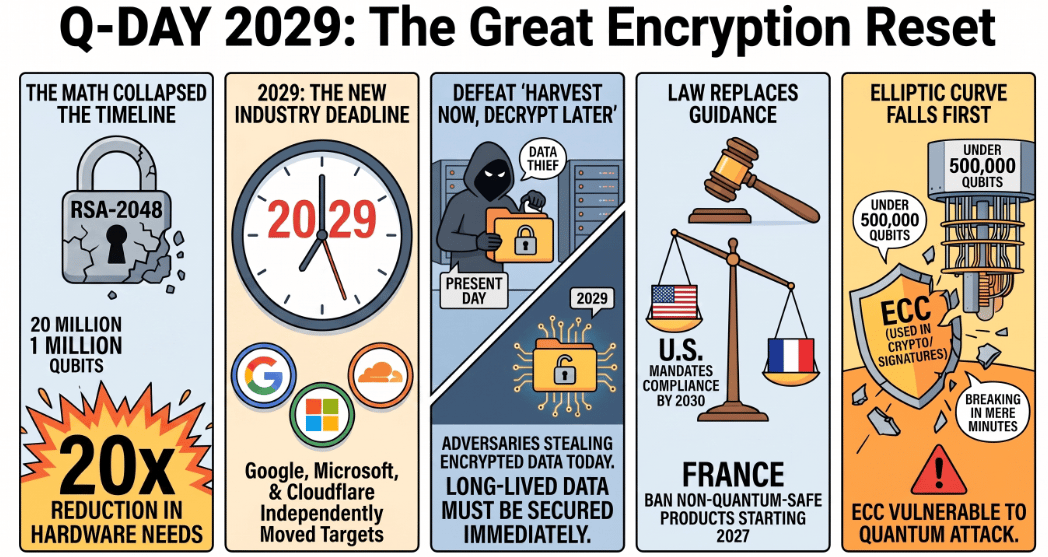
- Google, IBM, and Microsoft — the three leading quantum computer builders — predict 2029 is when classical RSA and ECC encryption stop protecting data worldwide. Your liability begins when the data is stolen, not when a quantum computer breaks the encryption.
- PQC+ Starts Here: Citi projects that if a top-5 US bank was hacked by a quantum computer it would cost the US economy trillions.
- Quantum Explained: YouTube's top 10 videos explaining why quantum computers are a civilization-changing technology.
- Q-Day: Two well-cited PDFs and 2 videos get you up to speed quickly. Recent technological developments have accelerated Q-Day — it is no longer a physics research effort but instead an engineering scaling problem.
Adversaries aren't waiting for 2029.
- Cybercriminals are actively harvesting your encrypted data right now to decrypt the moment quantum capability arrives. This is known as Harvest Now, Decrypt Later (HNDL).
- The HNDL Payday: This strategy is the “ultimate treasure hunt” for state actors (China, Russia, Iran) and cybercriminals, as they store stolen encrypted data awaiting a powerful enough quantum computer.
- Staggering Cost: A HNDL attack on a top-5 bank is estimated by the Federal Reserve and Citi Bank's institute to cost the U.S. economy between $2.0 trillion and $3.3 trillion.
- Massive Financial Impact: The FBI and NSA have estimated that China has stolen $250 billion to $500 billion in U.S. Intellectual Property annually for years — a figure that has dramatically increased due to HNDL.
- Your Liability is Immediate: Your legal and regulatory liability begins the day your data is stolen — not the day it is eventually decrypted.
- China open-sourced its quantum computer operating system in 2026, which many believe was a tactical political PR move to create plausible deniability for “future rogue” cybercriminal actions.
One platform. Four converging problems. Zero rip-and-replace.
Most enterprises buy four separate tools and still have gaps. PQC+™ is the only platform that addresses Regulatory Compliance, AI Security, Post-Quantum Encryption, and Mobile/Drone Defense in a single unified posture — and retires the overlapping point tools you're already paying for.
PQC+™ Platform Capabilities
NIST PQC Algorithm Suite
Production ReadyImplements FIPS 203 (ML-KEM / Kyber), FIPS 204 (ML-DSA / Dilithium), and FIPS 205 (SLH-DSA / SPHINCS+) — the finalized NIST post-quantum cryptography standards.
Hybrid Cryptography Mode
Production ReadyOperates in hybrid mode combining classical (RSA/ECC) and post-quantum algorithms simultaneously — protecting data even if either system is compromised. Zero downtime migration.
HNDL Defense Layer
Production ReadyHarvest Now, Decrypt Later protection via perfect forward secrecy combined with post-quantum key encapsulation. Adversaries capturing traffic today cannot decrypt it with tomorrow's quantum computers.
Regulatory Compliance Automation
Production ReadyAutomatic alignment with HIPAA, GLBA, SOX, FISMA, and DOJ-DSP encryption requirements. Continuous compliance posture monitoring with auditable evidence generation.
AI Security Layer (MCP)
Production ReadySecures AI infrastructure against Model Context Protocol (MCP) exploitation. Cryptographic attestation ensures AI models haven't been tampered with or poisoned.
MDM & Drone Defense
Production ReadyPost-quantum secure mobile device management combined with drone detection and neutralization using encrypted command channels.
Start Your Compliance Journey.
Our security and compliance experts will assess your current posture, identify gaps, and build a clear roadmap to quantum-safe compliance — before the penalties hit. No sales pitch. We lead with a gap assessment.
- Fast compliance gap assessment
- PQC+™ implementation roadmap
- State & federal penalty review
- Dedicated compliance partner